
18+ only. This guide is general information for adults in Great Britain, not encouragement to gamble. Gambling involves risk; only gamble with money you can afford to lose. For free, confidential support, call the National Gambling Helpline on 0808 8020 133, 24 hours a day.
Key points
- Inside bets cover single numbers or small groups and pay more but win less often; outside bets cover large groups and pay less but win more often.
- An 18-number bet such as red or black wins about 48.6% of spins on a single-zero European wheel and 47.4% on a double-zero American wheel.
- La partage and en prison are French rules that can return part or all of an even-money stake when zero comes up.
- Tables set minimum and maximum stakes, often with separate limits for inside and outside bets.
- No betting system changes the odds; every roulette bet carries the same house advantage.
Roulette comes with its own shorthand. Croupiers call out fixed phrases, the layout is covered in printed boxes, and two bets that look similar can pay 35 to 1 and 17 to 1 respectively. This glossary explains the terms you are most likely to meet, grouped roughly from the wheel itself out to the edge of the table. For the wider vocabulary of probability, our glossary of odds and probability terms covers the words used across casino games.
The Wheel and the Table: Layout Terms
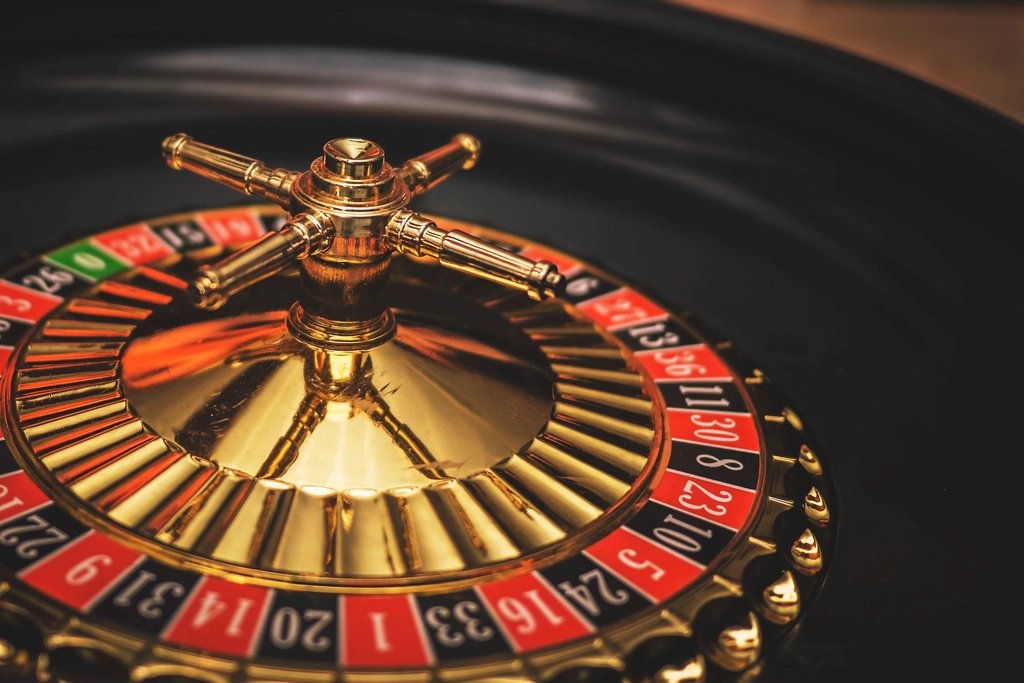
- Wheel. The spinning bowl holding the numbered pockets. European wheels have a single zero, American wheels add a double zero, and the French version is usually a single-zero game.
- Pocket. One of the numbered slots on the wheel where the ball can come to rest.
- Pill. The ball itself, sometimes called the pill on table signs and in guides.
- Betting layout. The printed board beside the wheel, showing every number and the boxes for the group bets. Chips go on the layout, not the wheel.
- Inside and outside. The two halves of the layout. Inside bets sit on the numbers; outside bets sit on the boxes grouped around the edges.
- Variations. The three major versions of the game, which has been played since the seventeenth century and originated in France, are French, European and American roulette.
Inside Bets: Straight, Split, Street, Corner and Six Line
- Straight up. A bet on one single number, including zero. It pays 35 to 1, the largest standard payout on the layout, and wins least often.
- Split. A bet on two adjacent numbers, placed on the line between them. It pays 17 to 1.
- Street. A bet on three numbers in a row, placed at the end of the row. It pays 11 to 1.
- Corner. A bet on four numbers that meet at a point, placed where their corners touch. It pays 8 to 1.
- Six line. A bet covering two adjoining streets, six numbers in total. It pays 5 to 1.
- Basket. A bet covering zero together with the first few numbers of the layout. On a double-zero wheel the basket carries a worse edge for the player than the standard bets.
Outside Bets: Red or Black, Dozens, Columns and Evens
- Red or black. A bet on the colour of the winning pocket, covering 18 numbers. It pays even money, and loses on zero unless a French rule applies.
- Odd or even. The same structure: 18 numbers, even money payout, zero loses.
- High or low. A bet on the low range, 1 to 18, or the high range, 19 to 36. Again even money.
- Dozen. A bet on one block of twelve numbers, marked 1st 12, 2nd 12 or 3rd 12. It pays 2 to 1.
- Column. A bet on the twelve numbers in one vertical column of the layout. It also pays 2 to 1, covering about 32.4% of spins on a European wheel and 31.6% on an American wheel.
Outside bets win more often because they cover large sections of the wheel, which is why their payouts are smaller. The trade-off is general: the lower a bet’s chance of winning, the more it pays when it does land.
Payouts and Odds at a Glance
| Bet | Numbers covered | Typical payout |
|---|---|---|
| Straight up | 1 | 35 to 1 |
| Split | 2 | 17 to 1 |
| Street | 3 | 11 to 1 |
| Corner | 4 | 8 to 1 |
| Six line | 6 | 5 to 1 |
| Dozen or column | 12 | 2 to 1 |
| Red/black, odd/even, high/low | 18 | 1 to 1 |
An 18-number bet wins about 48.6% of spins on a single-zero European wheel and 47.4% on a double-zero American wheel, because zero counts against every outside bet. The gaps in that table are not accidental. The payouts are set so that every bet on a given wheel carries the same house advantage, and no combination of bets removes it, as our article on the house edge explains.
Rules You May Hear: La Partage and En Prison
- La partage. A French rule applying to even-money bets such as red or black. When the ball lands on zero, the player receives part of the stake back rather than losing it all.
- En prison. A related rule on some French tables. Instead of taking part of the stake, the croupier holds the even-money bet in prison for the next spin, and the stake returns if that spin wins.
- Call bets. Bets placed by name on sections of the wheel rather than spots on the layout, such as the neighbours of zero. They appear mainly on French-style tables and cover numbers that sit together on the wheel.
Table Limits, Stakes and Croupier Terms
- Table limits. The minimum and maximum stakes for each bet. Tables often set separate limits for inside and outside bets, and the outside minimum is usually higher.
- Colour chips. At a live table, chips of one colour belong to one player, so the croupier can see whose money is where.
- No more bets. The call the croupier makes as the ball slows, closing all betting until the result is known.
- Dolly. The small marker placed on the layout over the winning number while payouts are made.
- Clearing and paying. The croupier clears losing chips and pays winners, working from the outside of the layout inwards.
Warning
No system of choosing or combining bets changes these odds, because every spin is independent and every bet carries the same edge. Over a longer session, the expected cost of playing simply grows.
If you want the arithmetic behind those payouts, start with our article on the house edge, and if you plan to play at all, our guide to setting gambling limits explains how deposit limits, time-outs and reality checks work before you sit down at a table.
Questions answered
What is the difference between inside and outside bets in roulette?
Inside bets sit on the numbers themselves and cover one number or small groups, so they pay more but hit less often. Outside bets sit at the edge of the layout and cover large groups of numbers, so they pay less but win more frequently.
How much does a straight-up bet pay in roulette?
A straight-up bet on a single number typically pays 35 to 1. A split pays 17 to 1, a street 11 to 1, a corner 8 to 1 and a six line 5 to 1.
What happens to red or black bets when zero lands?
On most wheels the bet simply loses. On French tables offering la partage or en prison rules, part or all of an even-money stake can be returned or held for the next spin instead.
Do European and American roulette wheels differ?
Yes. A European wheel has a single zero and an American wheel has a double zero, which gives 18-number bets a slightly lower chance of winning on the American version.